
Menstruum, 2024
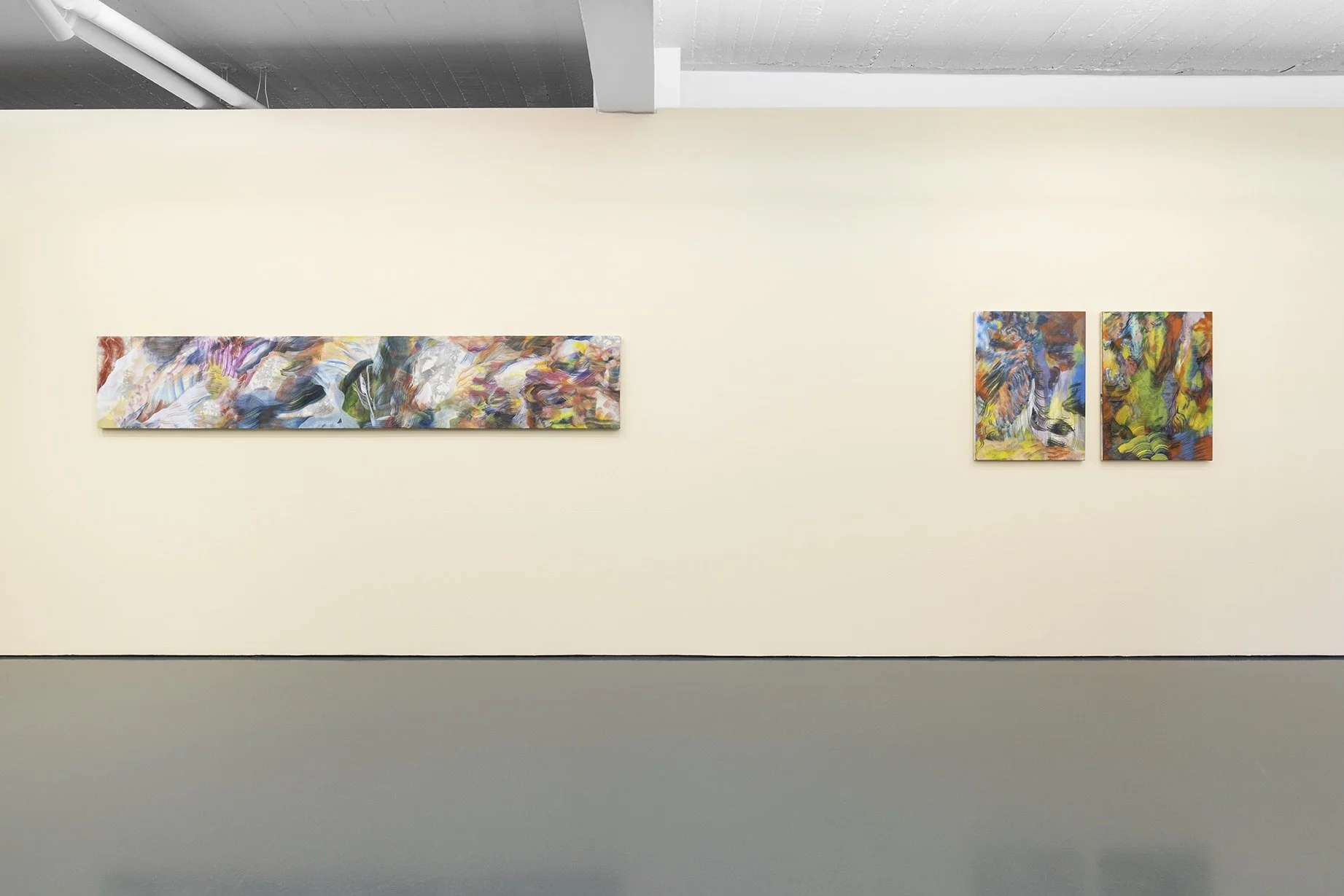
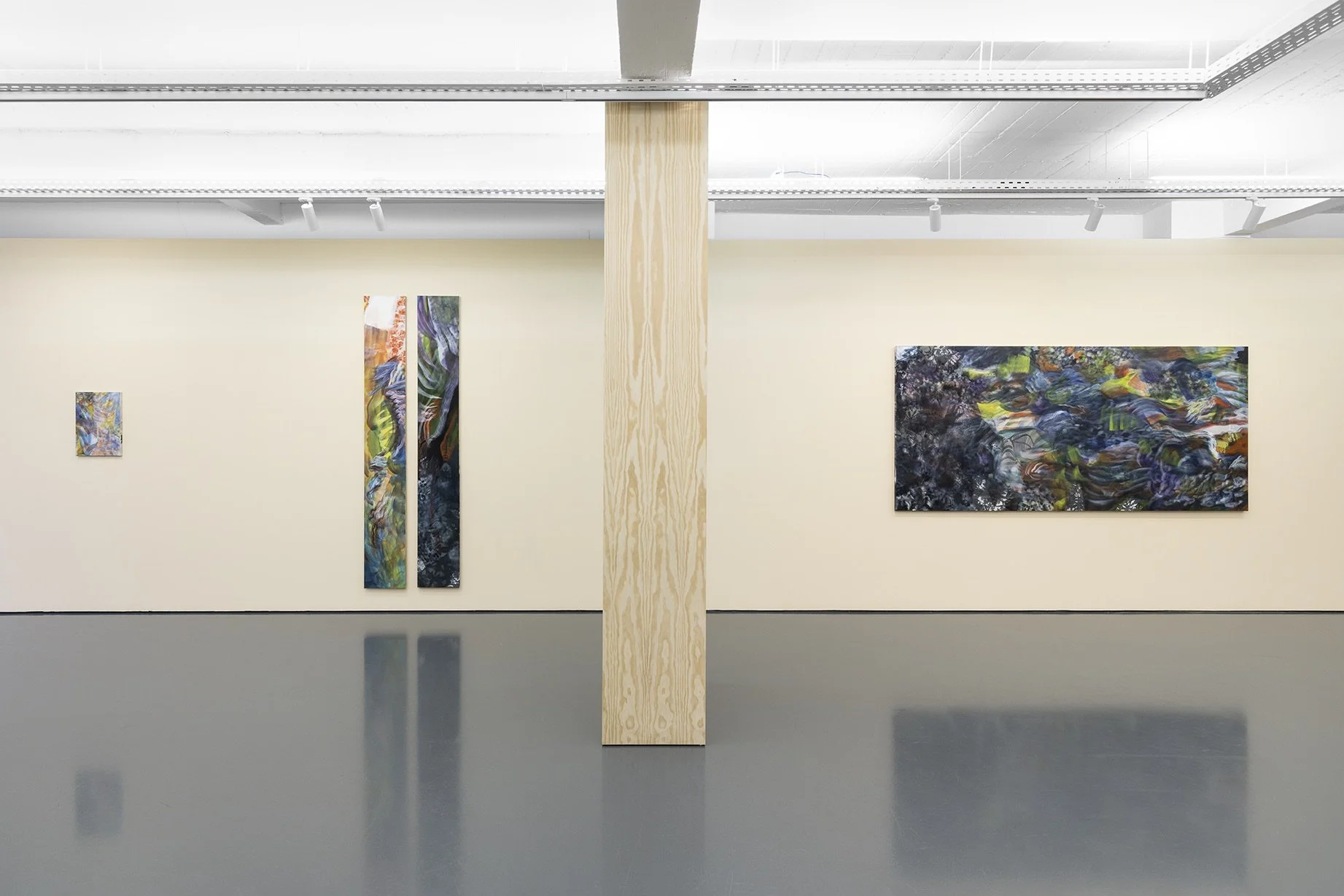
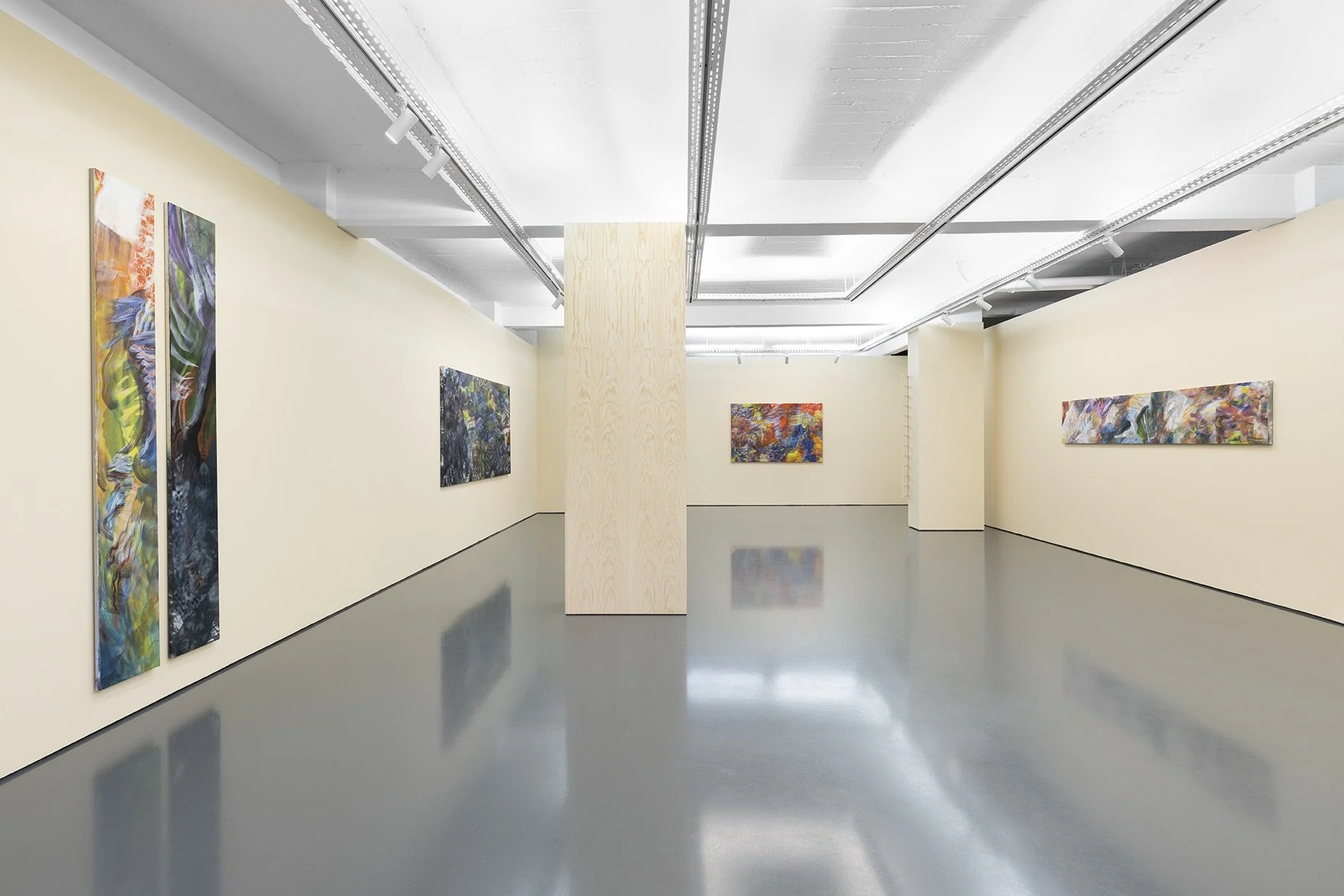
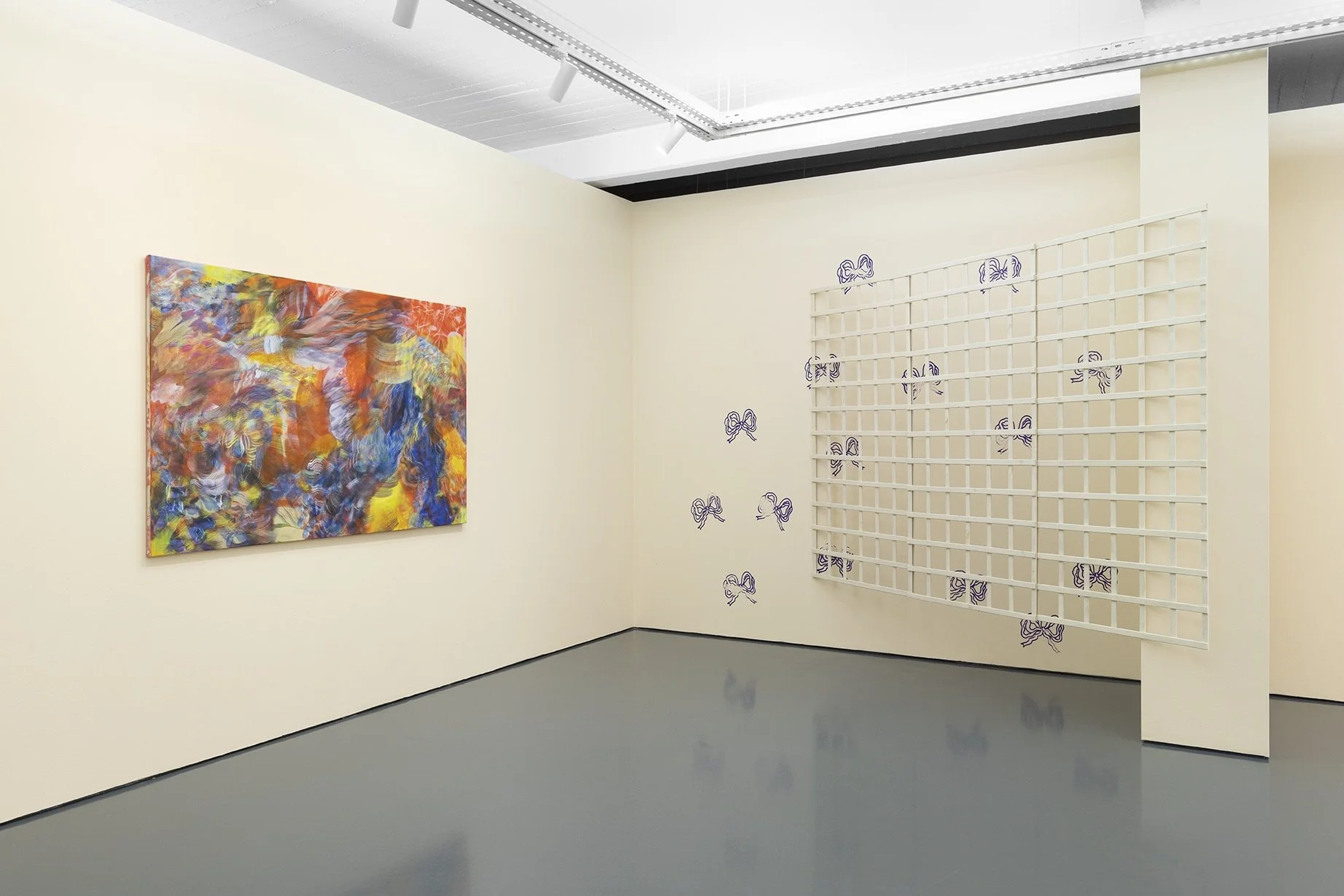
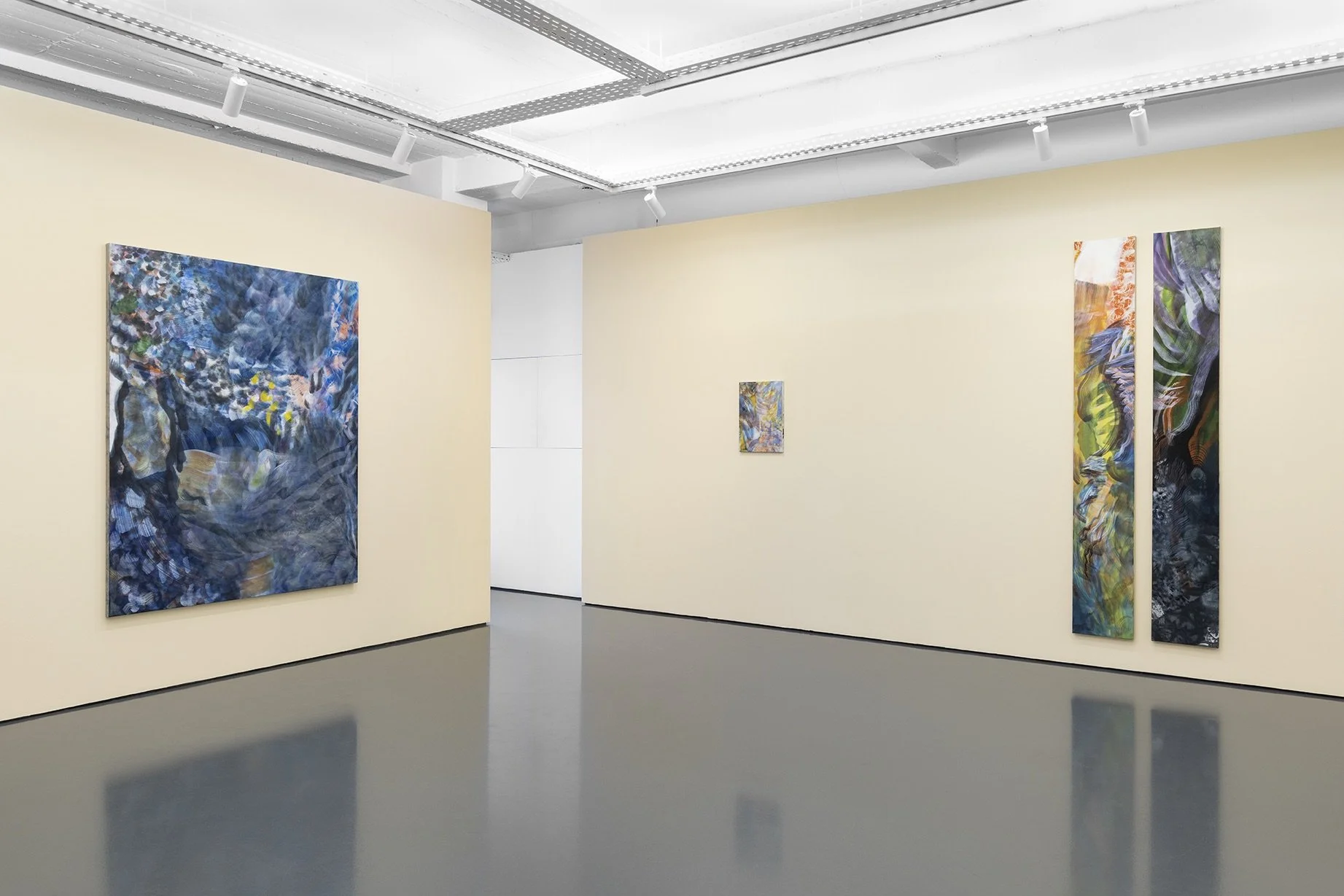
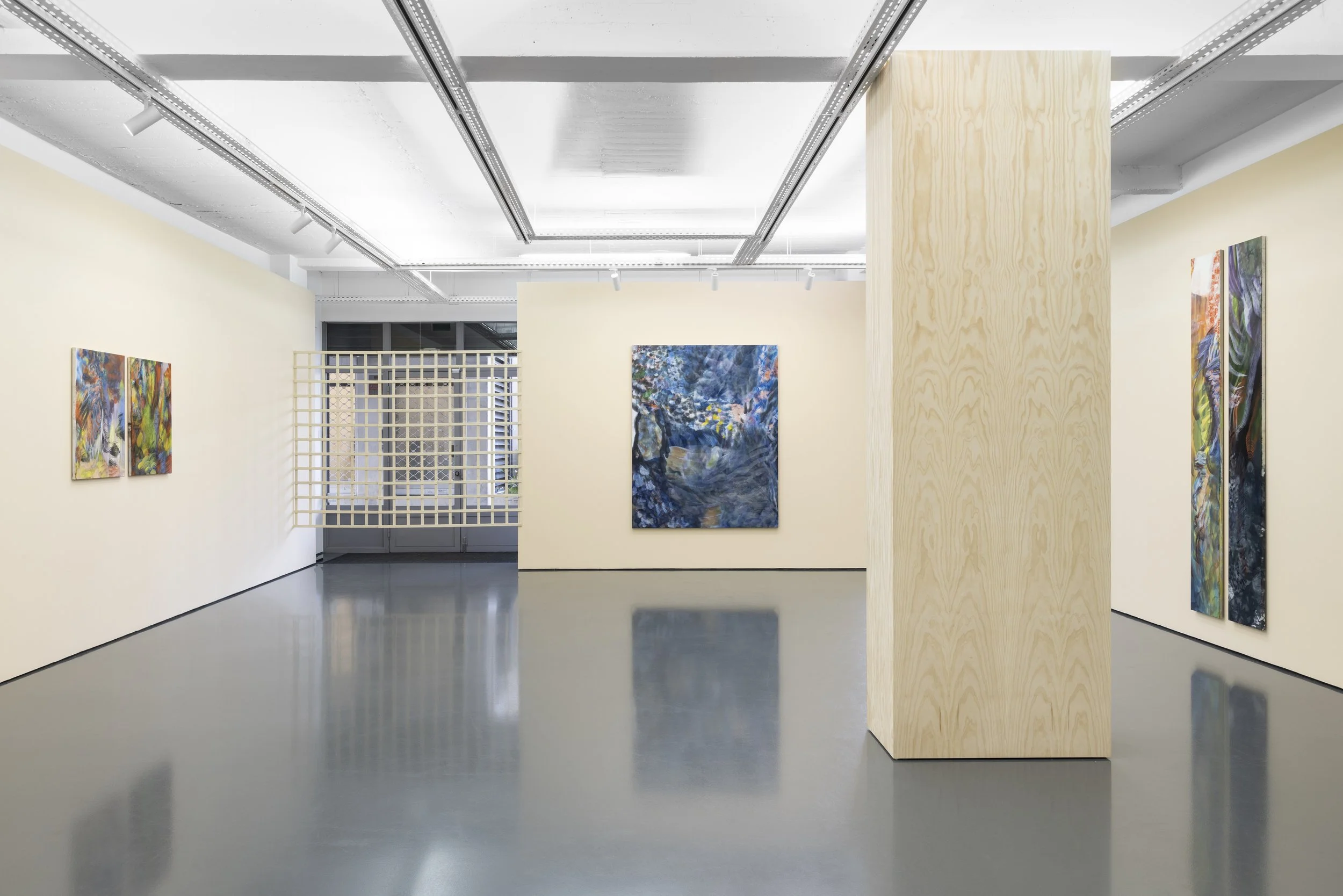
exhibition views, Galeria Pedro Cera, Lisboa
photography Bruno Lopes
“One line placed one the canvas committed her to innumerable risks, to frequent and irrevocable
decisions. All that in idea seemed simple became in practice immediately complex; as the waves
shape themselves symmetrically from the cliff top, but to the swimmer among them are devised
by steep gulfs, and foaming crests.”
Virginia Woolf 1
*
Led by a conscious being, who believes they can legitimately manipulate a series of techniques
and subjects, we can understand the act of painting (by which we mean making a painting)
as one of many processes of sedimentation in nature. However, what we might call a framed
geochemical micro-event loses all its inherent relevance where the nature of painting emerges
in the sensory phenomenon of sight. In this optical oxymoron (the painting), the settled
surface is presented as inevitably diaphanous in its own opacity; the painting refuses to be
simultaneously object and image – ‘a painting is a magic stone,’ as Ana Manso once said.
* *
What we unthinkingly call ‘inspiration’ can be understood as an interior process closely
connected to the spiritual world – indeed, this analogy lies in the very etymology of the
word. With a high level of occultism, this connection to the ‘beyond’ can be strengthened by
the figure of the medium; someone supposedly qualified to mediate between the material
and the spiritual world. In this metaphysical link, the medium abandons their own self to
exist, circumstantially, as a mere vehicle of a ghostly entity – the medium ‘disappears’ in the
tangibility of their own body to allow the spirit to appear. (Are we ultimately the mediums of
ourselves?)
In her work process, Ana Manso tries not to obey any specific programme, surrendering herself
to the fluidity of continual spontaneous unions between thought and practice, mental space
and physical space, as if she assumed the role of medium for the paintings she makes. She
allows the paintings to materialise themselves, to ‘paint themselves’ through her interventions,
during her sessions (seances) in her studio.
* * *
Menstruum is, in an alchemical context, a synonym for medium. This obsolete word can mean
a solvent in which to dilute materials or a nutritious and generative serum, as well as referring
directly to the menstrual cycle. Based on the semantic and etymological deconstruction of this
word, Ana Manso directs the title of this exhibition, Menstruum, towards a potential objection
to the dualistic and patriarchal resonances intrinsic to a certain modernist idea of the medium
and its more consensual narratives.
From Menstruum – which refuses to be a medium here – the artist questions and develops
various fundamental aspects of her work. Her painting feeds off a reciprocal relationship
between painter and painting, a circular relationship without hierarchy that opposes a binary
perspective of unilateral action, based on the thinking man’s domination of nature, on the
sovereignty of subject over object.
Ana Manso seeks a process of constant renewal, a cycle of full equivalence between end and
start, interior and exterior, creator and work; a blurring of dualisms that is reinforced in the
depth of the meanings of menstruum. Each painting emerges from an intertwining in which
there is always something sacrificed for the appearance of (an)other, an undulating chain
(push-pull) that evokes a behaviour in a permanently liquid state; a painting in lunar time. The
latter, in turn, is intimately involved in female menstrual cycles and in the functioning of the
tides2. This is also a way to emphasise the refusal of a disincarnate understanding of painting
and of the more erect ideas of pure optics.
Ana Manso seeks to explore the infinitely regenerative nature of the pictorial experience; for
a painting never exists alone nor is it an end in itself – we ‘repaint’ it in a different way every
time we look at it. Like the act of painting, seeing a painting is simultaneously an exercise of
loss, given that to ‘have’ that painting we must be sacrificing all other possible paintings: by
focusing on a certain detail, we lose all others at that moment, and if we try to see the painting
as a whole, we lose its details3. There is always a phantasmagorical side hovering over the
painting.
* * * *
In Menstruum – her fifth solo exhibition at Galeria Pedro Cera – Ana Manso once again
presents her painting in a desecrated way, bringing together in the same installation a
group of paintings of different sizes, including screen prints, murals and interventions in
the architecture of the exhibition space, highlighting once again that, for her, painting is
undeniably a permeable entity contaminated by the various uncertainties and subtleties of life
experiences.
In her new series of paintings, contamination is also a principle inherent to the creation
process, for the way it connects oil painting on canvas – in its most immaculate sense – with
a series of techniques of lesser historical nobility, such as tie-dye, stamping or stencilling. In
this way, Manso explores various nuances of the painting’s spatial and temporal instability,
applying a range of solutions to the textile surface: dyeing the forces of contortion in the
support itself (tie-dye), ghostly spraying (stencil), full and instantaneous contact (stamping)
and, naturally, the marks of bristles loaded with oil paint. The thin layers of paint interweave
organically with each other and with the various ‘intrusive’ elements, on a plane of energy that
insists on slipping away. We strive to see it, but the surface of the painting does not exist.
Lisbon, February 2024
João Marçal
__________________________________________________________
1 WOOLF, Virginia – To the lighthouse [1927], London: J. M. Dent & Sons LDT, 1964. p. 182.
2 Cf. ARMSTRONG, Carol – Virginia Woolf and the time of painting. In Cézanne’s gravity. Yale University Press, 2018. p. 41-45.
3 Cf. ARASSE, Daniel - Le Détail: Pour une histoire rapprochée de la peinture [1992]. Paris: Éditions Flammarion, 2009.